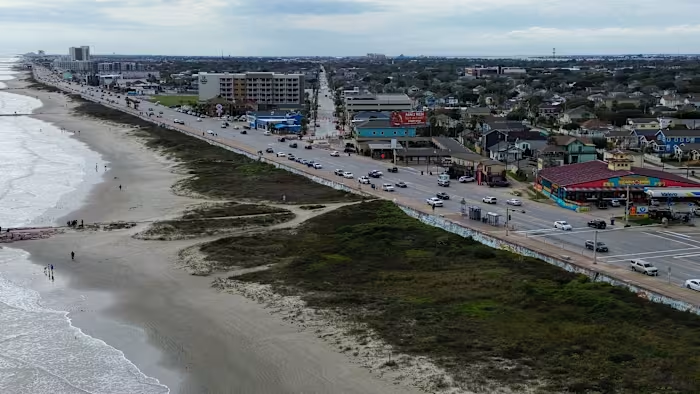
Galveston officials have begun clearing large amounts of sargassum from beaches ahead of Memorial Day weekend, as federal monitoring shows elevated levels of seaweed along the Texas coast.
.png)
Heavy machinery was deployed by crews in Galveston this week to remove significant accumulations of seaweed from public beaches, coinciding with a surge of sargassum just days ahead of the bustling Memorial Day holiday.
The Galveston Island Park Board of Trustees commenced mechanical cleanup operations on Tuesday, following a significant buildup that had reached levels necessitating intervention to ensure continued beach access, as reported by local officials.
Workers have begun removing seaweed from the shoreline to improve conditions for visitors, as the upcoming holiday weekend is expected to draw large crowds to the coast.
The recent influx indicates a larger, ongoing trend that we have observed repeatedly over time. Researchers report that sargassum blooms have been increasing each year since 2011, a trend attributed to warming ocean temperatures and elevated nutrient concentrations. The brown seaweed begins its journey in the Sargasso Sea, subsequently making its way into the Gulf of Mexico and the Caribbean. Ultimately, it finds its way to the shores of the Gulf Coast.
Monitoring agencies such as the National Oceanic and Atmospheric Administration and the University of South Florida track sargassum levels daily. The report released on May 20 has categorized Galveston Bay as having a “medium” risk for seaweed accumulation. In contrast, regions stretching from Bolivar Beach to McFaddin National Wildlife Refuge have been designated with a “high” risk level.
Officials have highlighted that, despite ongoing cleanup efforts, sargassum serves a significant ecological function. It serves as a crucial habitat for marine life and plays a significant role in stabilizing beaches by mitigating erosion when left undisturbed.
As a result, large-scale removal is generally limited to instances of severe conditions. The benchmark for significant accumulation was established in 2014, when researchers from Texas A&M University at Galveston recorded more than 8,400 tons of seaweed arriving along a 3.3-mile stretch of beach in a single day, marking the most severe year on record for the region.
Researcher Robert Webster expressed concern, stating, "One of my fears is that what’s happening now will become the norm instead of the exception.
Officials have indicated that it remains uncertain whether this year's surge will reach those levels. Federal agencies are urging the public to utilize online tools to report notable seaweed sightings, aiming to enhance forecasting and response initiatives.
For now, crews continue working to keep Galveston’s beaches accessible as visitors arrive for the holiday weekend.